On the boundary between Epsom and Cheam lies a royal secret that few passers-by would notice. Nonsuch Palace, once Henry VIII's most extravagant architectural statement, has vanished completely; yet its absence tells a story of Tudor ambition, Renaissance innovation, and the ruthless economics of the 17th century.
A Village Sacrificed for Royal Splendour
Construction began on 22 April 1538, just six months after the birth of Edward VI. Henry VIII ordered the entire village of Cuddington demolished to make way for his new palace; the 12th-century church, manor house, and great barn were all razed. Landowner Richard Codington received compensation in the form of the dissolved Priory and manor of Ixworth in Suffolk. The workforce numbered approximately 500 men, whilst materials flooded in: 3,600 tons of stone from Merton Priory, 96 loads of Reigate stone, 259,000 tiles from Kingston and Streatham, and 1,000 loads of timber.
The name itself announced its purpose. "Nonsuch" boasted that no equal existed in Europe; the palace was designed specifically to outshine Francis I's Château de Chambord. It became England's first major Renaissance building, introducing Continental architectural ideas through Italian craftsmen including Nicolas Bellin of Modena, who had previously worked at Fontainebleau.
The Architecture of Propaganda
Nonsuch Palace consisted of two quadrangles sharing a common wall. The outer courtyard measured 150 feet by 132 feet, built in plain, castle-like stone. The inner courtyard stretched 137 feet by 116 feet and contained the palace's true marvel: three tiers of elaborate stucco reliefs moulded in high relief.
The decorative scheme was unmistakably political. Roman emperors stood on the top tier; gods and goddesses occupied the middle; the west wall displayed the Labours of Hercules, whilst the east showed the Liberal Arts and Virtues. At the centre of the south wall, Henry VIII appeared alongside Prince Edward. Timber framing clad with carved slate and gold leaf set off the white reliefs. Octagonal towers with onion-shaped cupolas flanked the ornate south front, whilst the northern face remained fortified in medieval style.
Royal Patronage and Eventual Decline
Henry VIII died in 1547 with the palace still incomplete. Mary I sold the unfinished building to Henry FitzAlan, 12th Earl of Arundel, in 1556; he finished construction by 1559 and entertained Elizabeth I there. The Treaty of Nonsuch, signed in 1585, committed England to supporting the Dutch against Spain. Elizabeth I purchased the palace outright between 1590 and 1592 for £534.
The Stuart monarchs maintained the tradition. James I granted it to Anne of Denmark; Charles I transferred it to Henrietta Maria in 1626. The Civil War brought confiscation and leasing to Parliamentarian supporters, though the Restoration returned it to the Crown in 1660.
The End of Nonsuch
In 1670, Charles II gave the palace to Barbara Villiers, Duchess of Cleveland, his mistress, and created her Baroness of Nonsuch. Her gambling debts sealed the palace's fate. After reportedly losing £20,000 in a single night, she ordered Nonsuch demolished between 1682 and 1683. The materials, valued at £7,020 in 1650, were sold off piece by piece.
No trace of the palace remains on its original site today. Some wood panelling survives at Loseley Park near Guildford; other fragments rest in the British Museum. Three small stone columns with plaques now mark the ground plan in Nonsuch Park. Archaeologist Martin Biddle's 1959-60 excavation revealed the palace's layout and helped establish post-medieval archaeology as a discipline in Britain.
Nonsuch Today: Local Heritage and Public Space
The site now forms part of Nonsuch Park, straddling the boundary between Epsom and Ewell Borough Council and the London Borough of Sutton. The two councils have jointly managed the park since 1937; Surrey County Council holds the title deeds in trust. This represents the last surviving portion of the Little Park of Nonsuch, originally 671 acres.
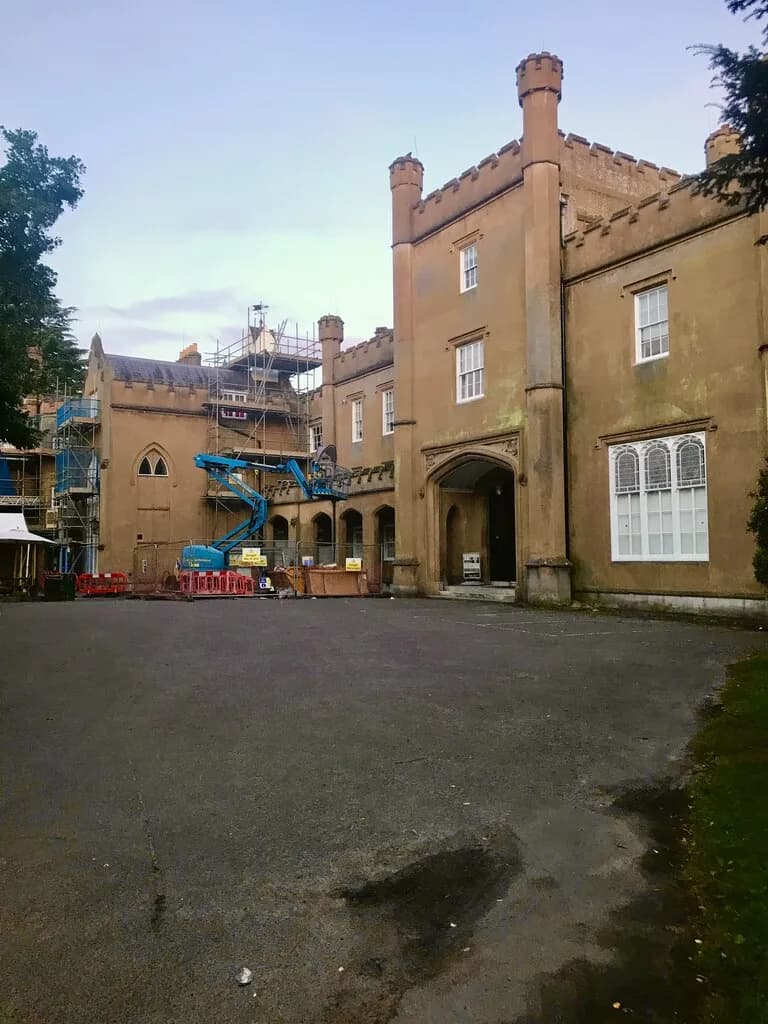
Nonsuch Mansion, a Grade II* listed building constructed between 1802 and 1806 by Sir Jeffry Wyattville, stands within the park but not on the palace site. The foundations of the palace's Banqueting House remain visible near the A240, where a retaining wall rebuilt in the 19th century incorporates original Tudor bricks. Visitors today can follow the London Loop through the park, join the weekly Saturday parkrun, or explore the flower gardens where a Tudor king once displayed his power to the world.