The Birth of a Victorian Mental Health Complex
The Epsom Cluster, also known as the Horton Estate, stands as one of the most ambitious healthcare projects of its era. In 1896, the London County Council acquired 1,096 acres of land west of Epsom for £35,900 with a grand vision: to build six hospitals capable of housing up to 12,000 patients to relieve overcrowding in London's asylums.
Ultimately, five hospitals were constructed across the estate. Manor Hospital opened first in 1899, followed by Horton Hospital in 1902, St Ebba's Hospital in 1904, Long Grove Hospital in 1907, and finally West Park Hospital in 1923. The cluster operated as a self-contained community with its own Horton Light Railway for transporting supplies, a central cemetery on Hook Road, and dedicated waterworks and power stations. The hospitals were nationalised in 1948, becoming part of the newly formed National Health Service.
The Five Hospitals and Their Distinct Histories
Each hospital within the cluster developed its own specialisations and histories. Horton Hospital became notable for its pioneering malaria research unit, established to treat general paralysis of the insane. The unit eventually became the World Health Organisation's Regional Malarial Centre for Europe, operating until 1975 when penicillin rendered the treatment obsolete. The hospital also pioneered music therapy during the 1960s and later hosted the controversial Wolvercote Clinic from 1995 to 2002, which treated sex offenders with reported success rates of 80 per cent non-reoffending.
Long Grove Hospital gained notoriety for darker reasons. From 1907 until the hospital's closure in 1992, forty-three female typhoid carriers were detained in a secure isolation unit without parole. A BBC investigation in 2008 revealed the women were kept in "prison-like conditions," drawing attention to the ethical questions surrounding indefinite detention. The hospital also counted several famous patients amongst its residents, including Titanic survivor George Pelham, violin prodigy Josef Hassid, and gangster Ronnie Kray.
Manor Hospital, the first to open, was built around the existing Horton Manor House. During the First World War, it served as Manor War Hospital for casualties from 1916 to 1919. By 1951, it had expanded to 1,417 beds and gained an international reputation for industrial and behavioural therapy.
St Ebba's began as the Ewell Epileptic Colony in 1904, originally housing 326 epileptic patients at a construction cost of £98,000. It became Ewell War Hospital in 1918 for neurasthenic ex-servicemen, then evolved into Ewell Mental Hospital in 1927. The hospital was renamed St Ebba's in 1938 and by 1979 had become the largest hospital for mentally handicapped patients in the district with 629 beds.
West Park Hospital, the final addition, opened in 1923 and never officially carried the "asylum" designation. At its peak, it housed around 2,000 patients of mixed class and featured extensive facilities including boiler houses, a large laundry, a substantial water tower, and a recreation hall with ballroom.
The End of an Era: Closure and Demolition
The demise of the Epsom Cluster began with Enoch Powell's watershed "Water Tower speech" in 1961, which called for the winding down of institutionalised care. The 1980s Care in the Community policy accelerated the closures.
Long Grove Hospital was the first to close in 1992. Manor Hospital followed in 1996, with Horton Hospital closing in 1997. West Park Hospital, after seeing most of its patients discharged during the 1990s, finally closed in 2003. Its main hall was destroyed by arson on 30 September 2003, just months before the hospital's official closure.
St Ebba's underwent partial closure, with some services continuing to operate. As of 2004, fifty-five long-stay handicapped patients remained in converted buildings, and a purpose-built Therapy Suite with hydrotherapy pool opened in 2008.
From Healthcare to Housing: The Redevelopment
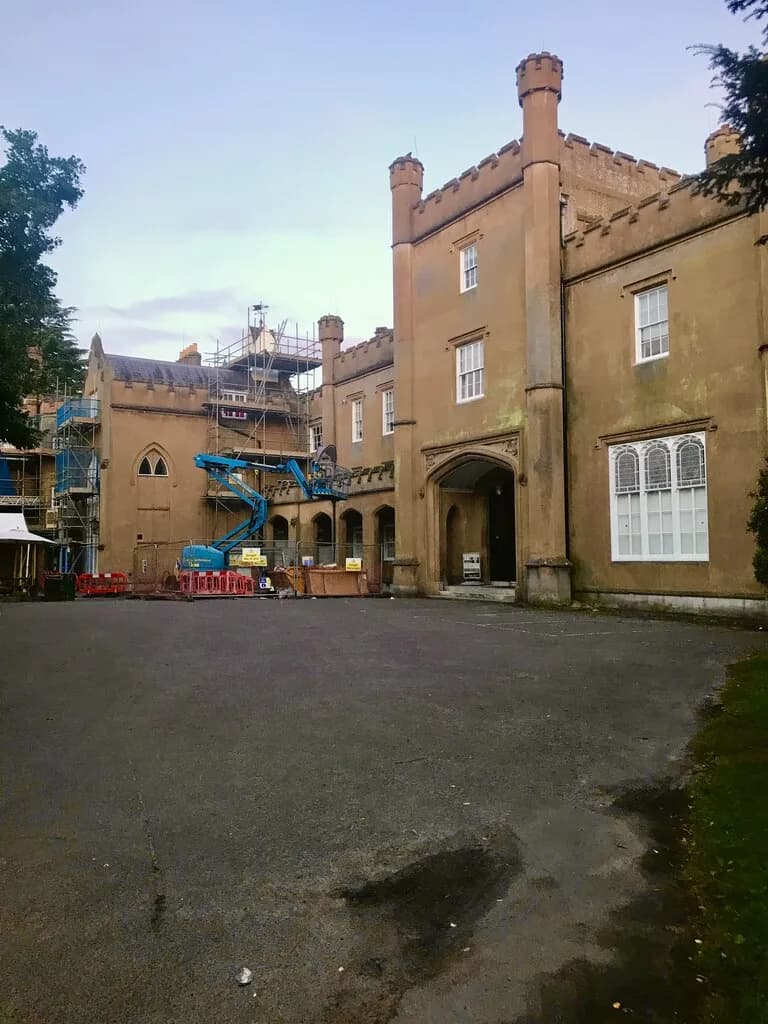
Today, the former hospital sites have been transformed into residential communities. The Manor Hospital site is now the Manor Park housing estate, with the Manor House, Medical Superintendent's house, three service blocks, and both porter's lodges converted to residential use.
Long Grove Hospital's grounds have become Clarendon Park, a development of houses and flats, whilst parts of the grounds were preserved as Horton Country Park, designated as a Local Nature Reserve.
West Park Hospital gave way to Noble Park, a housing development completed in April 2012. The development retained the water tower, administration building, and limited wards, converting them to apartments. The New Epsom and Ewell Cottage Hospital remains operational as an NHS facility on the site.
Horton Hospital saw most of its buildings demolished, though the administration block was converted to private apartments, and the chapel and superintendent's residence were retained. Horton Haven psychiatric unit continues to operate on the site. The distinctive water tower was demolished by October 2012.
A Complex Legacy
The transformation of the Epsom Cluster reflects broader shifts in British mental healthcare policy. Bill Rashleigh, a former worker quoted by the BBC in 2011, questioned whether Care in the Community truly worked for all patients. "Some people need that kind of care," he observed, reflecting concerns that remain relevant today.
The redevelopment has brought significant housing to west Epsom whilst preserving some architectural heritage through the conversion of significant buildings. The NHS maintains mental health services at St Ebba's, Horton Haven, West Park, and The Manor, ensuring continuity of care even as the physical landscape has been transformed.
What stands today on the 1,096-acre estate bears little resemblance to the institutions that once dominated the area. Yet for local residents, the names of Manor Park, Clarendon Park, and Noble Park serve as reminders of this significant chapter in Epsom's history.